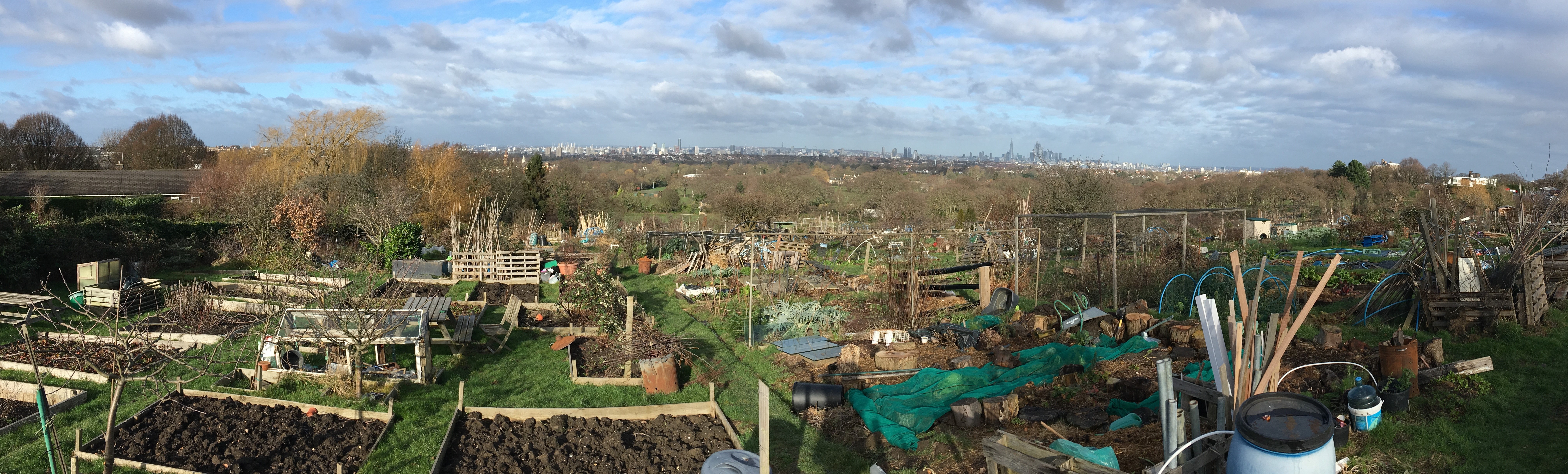
The land now occupied by Grange Lane Allotments has evolved through several distinct phases, each shaped by the wider history of Dulwich and the long stewardship of the Dulwich Estate. For centuries this hillside formed part of the southern edge of the Great North Wood, a broad expanse of ancient woodland that once covered much of South London. The ground here, lying just below Dulwich Wood on clay-with-flints over London Clay, would have been used for rough grazing, timber gathering and small‑scale charcoal production. It remained open and largely untouched, a rural margin on the Estate, long after other parts of London began to urbanise.
By the nineteenth century, estate maps show the area as open fields or paddocks, with Grange Lane itself serving as a track used by drovers moving livestock toward the London markets. The Dulwich Estate maintained tight control over development, and this pocket of land stayed agricultural in character. Even as suburban streets spread across nearby districts, the fields below Dulwich Wood remained undeveloped, preserving a sense of the older landscape. In the early twentieth century the land continued to be used for grazing or hay cutting.
During the Second World War, its elevated position and clear aspect made it suitable for civil defence, and it served as a barrage balloon site, part of the protective ring designed to hinder low‑flying aircraft approaching the capital. The brick shed at the edge of the current car park was small dormitory block for those involved. After the war the field returned to informal agricultural use, but the pressure for community growing space was increasing across London.
The shift to allotments came in the mid‑1960s, when local authorities and community groups sought additional land for cultivation. The Dulwich Estate released several parcels for this purpose, and the Camberwell & District Allotment Society took on the management of the Grange Lane site. By the late 1960s the land had been divided into plots, and the basic layout familiar today began to emerge. Over subsequent decades, water points, fencing and communal areas were added, and the site became a well‑established part of local community life.
In 2024 the Society formalised its structure as Camberwell & District Allotment Society Ltd. Today, Grange Lane Allotments reflects all the layers of its past: woodland edge, working field, wartime defence site and now a thriving community growing space rooted in the long history of this sheltered corner of Dulwich.