Rationale
Plots which are not effectively cultivated or maintained sometimes need to be reallocated. A temporary absense can be recovered from, as life can intrude on the best plans. But when this goes on too long, the plot can become a liability, allowing weeds to propagate and spread, and increasingly laborious to bring back to standard. It is also a wasted asset, as someone else might be enjoying its use.
Annual inspections are intended to ensure that minimum cultivation standards are being maintained and that there are no emerging health and safety hazards.
The process
We appreciate that there is no single template to which all allotments must adhere and they can be cultivated in many different ways. But neglect is not one of the options. Annual inspections are intended to ensure that minimum cultivation standards are being maintained and that there are no emerging health and safety hazards.
Allotment inspections take place around the end of May by members of the Committee and Line Managers. They are run on a similar basis each year, with the main focus on weed control and cultivation. We use a traffic light system:
- GREEN – good/good enough
- AMBER – improvement needed
- RED – urgent action required
All REDs are reviewed by a single team to ensure consistency and the colour coding then finalised . What happens next is summarised in this diagram. Following notification, AMBERS and REDS will be both be reinspected but on different schedules.
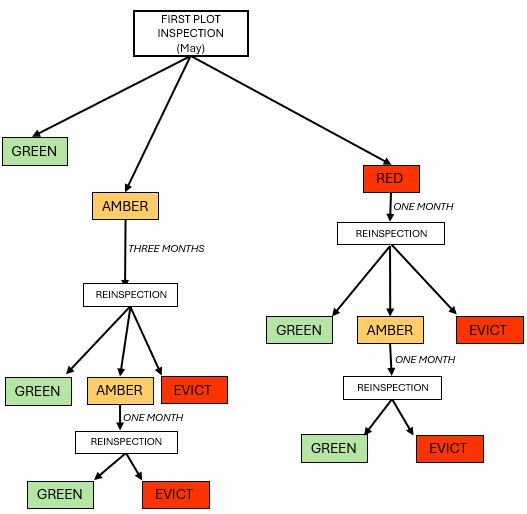
AMBERS are reinspected for the first time after three months and can either go GREEN (problems solved), AMBER (limited improvement) or RED (standards further deteriorated), with a RED leading to eviction. Allotments with a second AMBER are reinspected again after a month; if they then fail to pass as GREEN, eviction can follow.
For REDS, the process follows the same structure as AMBERS, but in a tighter timeframe, with the first reinspection after a month. This is necessary because an already neglected allotment can get a lot harder to resolve after a further three months of neglect.
OTHER ISSUES
The inspection also checks the existence/visibility of allotment labels and whether the paths have been recently mowed. Allotment holders may also receive notice of action required on these.
Additionally risks to health and safety on each allotment and surrounding paths will be identified. Any risk will be discussed with the relevant allotment holders so that the issue can be addressed and other allotment holders are not put at risk whilst moving around the site. We are all required to identify risks to health and safety as part of our CDAS membership and to ensure that our public liability insurance is not invalidated.
Please note, all efforts are made to keep plot holders who are able and committed to looking after their plots. If there are mitigating circumstances to explain the state of plot, these should be shared.